Wide Package
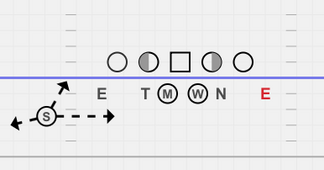 Wide alignment |
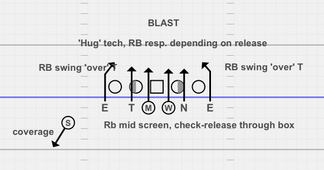 Blast |
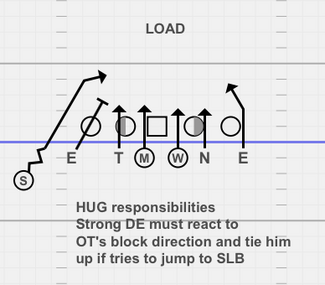 Load |
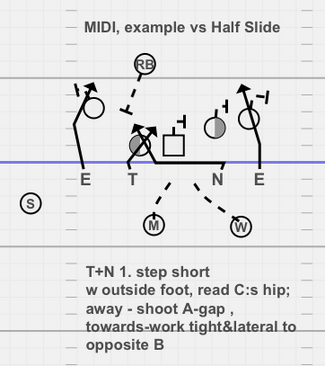 Midi |
 Tie |
 Will |
Using the Wide Package to disrupt opponent’s spread passing game
The examples used in this writing are from Team Finland’s current defensive playbook. National Team football is always installed fast with very little time for spesifics, that puts a lot of pressure on selecting the drills and the coaching points in an attempt to field effective schemes that the athletes can execute on the field. These illustrations and film clips aim to provide the basics for using these concepts if someone so wishes.
The key elements to make the package succesfull is to have all 4 DL with quick feet, compromise on size if needed, and to have LBs that can both blitz and get into pass coverage in a hurry. Sometimes it might be a good idea to train a LB strictly for these schemes and keep the surrounding pass coverage minimum to him. Good blitzers are rare, as are good coverage LBs’too.
So the Wide Package could easily include a partially separate personnel, too.
The film examples (https://www.youtube.com/watch?v=QLmxSwVuTlw) are from a 2015 game between Finland and Sweden in the Stockholm Olypic Stadium, October 3rd. Like always it was a very tight battle that could have ended either way. I think these schemes played a significant role in us winning 14-10. But more than anything else it was the effort of the players on the field.
1. Wide
The basic idea of the Wide Package is to use the DL and the LBs of a 43 defense from a single look in multiple ways to keep the offense under pressure and guessing. The word Wide refers to the DL alignment, both DTs are lined in a 3-tech over the guards, the DEs line up in wide 5 technique (also called 6 or ’Jet’). MLB and WLB line up over the A-gaps and SLB creates the 7-man threat with positioning adjusted to the offensive formation.
2. BLAST
We’ll start with the BLAST. This 6-man scheme has been a part of our playbook for a long time. It was run out of a 42 stack look for years, with crossing blitzers etc. And has now become a part of the Wide Package.
We send 6, and the 6 are responsible for both QB and the RB (s). We aim to get to ’hug’ them. The HUG dictates the final pass rushers. Edge rushing Des take on RB if he releases ’high’, over the OT, else the RB will ’hugged’ by whoever’s lane he steps on.
On the film (0:00-0:03) we get through the line and should sack/TFL the QB. He ran for some yardage, regardless.
3. LOAD
This is the extreme one, we’re sending 1 more than they can ever block, here against a spread 7. The HUG rules apply, and the SLB blitz side DE must react to the OT in front of him. In case of a Full Slide towards he must tie the OT to ensure SLB’s rush lane. This can be seen done well in the clip. Of the back end, the DBs must trust the QB having less than 2 seconds to get rid of the ball, read his body language and fly to the ball upon release.
On the film (0:04-0:08) we get to the QB untouched and force an errand pass.
4. MIDI
This is a read stunt between the interior DL. The LBs again show all out blitz on the A-gaps but bail on snap. The DL at 3-techs step one short jab step with their outside foot, read the C’s hips opening one way or the other and then start the stunt on their second step. If the center turns away from you your second step is a violent shoot and rip through the A-gap. If the C turns towards you, you scrape lateral and find the shortest way to the QB on the other side of him. Typically, this means working around to where the ’B gap’ now is on the other side. In the picture the RB is drawn to check his side for blitz, more often than not he will not see the stunt coming from the other side or has check released (into coverage) by the time.
On the film (0:09-0:16) we get a sack.
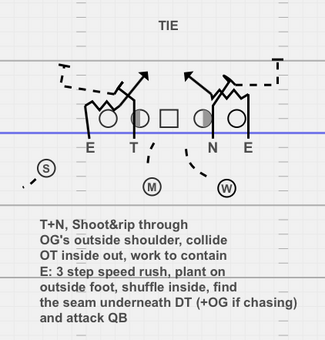
5. TIE
This stunt is run between the DE and the interior DL on his side. We run it on both sides with the call, but obviously this can be a one-side call also.
The DE ’speed rushes’ upfield for 3 steps, starting on the outside foot. The 3rd step is a ’plant’ from which he scrapes inside, shoulders square, feet not crossing, and finds the lane created by the interior player.
The interior DL shoots and rips hard through the outside shoulder of OG, upfield penetration is a must, and the lane can be a bit wide. He then aims at the inside shoulder of the OT and pushes him outside before working underneath to contain the possible escaping QB.
The guard will or will not try to follow the B-gap rusher. The rule for DE is that if the G is clinging on to the DT, he will scrape underneath both of them. If they’re separated he will work as tight underneath DT’s hip as possible.
On the film (0:17-0:27) our left interior DL does not work to contain fast enough, but we pressure the QB out of the pocket and force an incomplete pass.
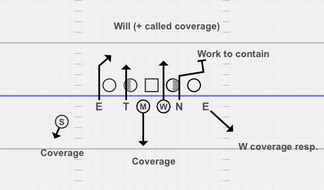
6. WILL
Finally, this is a simple exchange that can easily be added to the package. We’re sending one of the threatening LBs and droppinbg a DE to replace him in the coverage. Just make sure that the DT is aware of no outside rush and slow rushes to contain if needed, and also keep the pass reads very simple for the dropping DE.
On the film (0:27-) we get the QB to read tight man and blitz and to check swing to RB, our DE's coverage is else ok, but obviously he grabs an arm.
Film clips of described schemes, in the same order (BLAST; LOAD; MIDI; TIE; WILL)
https://www.youtube.com/watch?v=QLmxSwVuTlw